

Portfolio
Portfolio shows what you hold now, read live from your exchange.
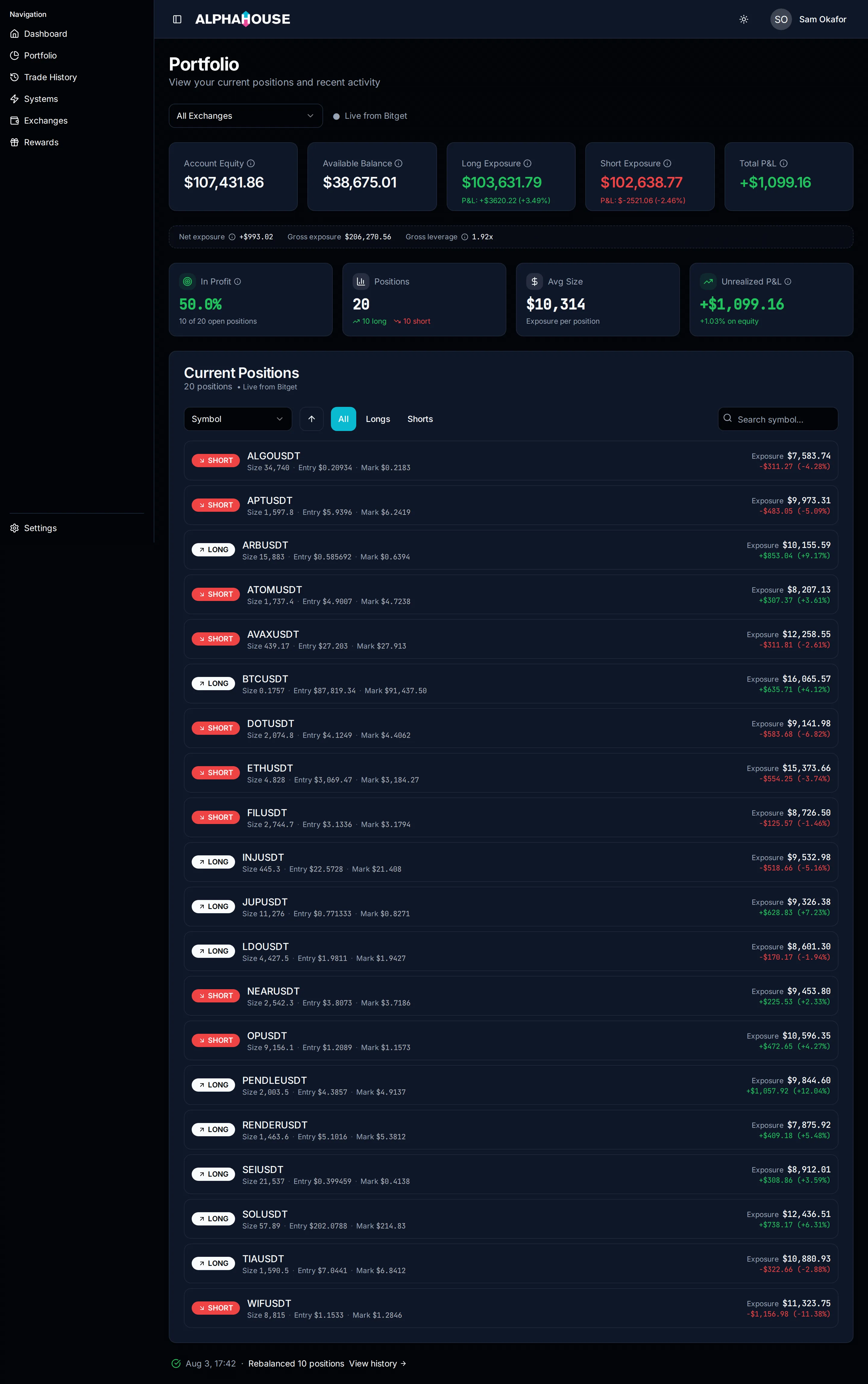
Portfolio on a market-neutral book of twenty positions.
Choosing which account you are looking at
Section titled “Choosing which account you are looking at”The exchange filter at the top picks which connected account the page reads from, and is shared with the Dashboard. If you have not picked one, the page selects the connection linked to an active trading system, otherwise the most recently added. A live indicator beside it names the exchange the figures come from.
If no connection is available, the page points you at the Exchanges page. If the data fails to load, an Account Data Error card shows the reason.
The five summary tiles
Section titled “The five summary tiles”
The five tiles, with the book-posture strip directly beneath them.
Each tile has an info icon carrying the explanation below.
| Tile | What it means |
|---|---|
| Account Equity | Total value of your account including cash and all open positions at current market prices. |
| Available Balance | Cash not currently used as margin for open positions. |
| Long Exposure | Total notional value of positions betting on price increases. |
| Short Exposure | Total notional value of positions betting on price decreases. |
| Total P&L | Combined unrealized profit or loss across all open positions. |
Long and Short Exposure each carry a P&L line underneath, in dollars and as a percentage of that side’s exposure.
The book-posture strip
Section titled “The book-posture strip”The thin strip below the tiles explains how they relate, because on a market-neutral book the exposure numbers legitimately run above your equity.
- Net exposure is long minus short. The strategy is market-neutral, so a figure near zero is expected: the book is not betting on market direction. It is shown neutrally rather than coloured.
- Gross exposure is long plus short.
- Gross leverage is gross exposure divided by equity. Above 1x is normal
here, and roughly 2x is the usual picture. If equity cannot be read, it shows
--rather than a made-up number.
See leverage for how your leverage setting relates to this.
Position metrics
Section titled “Position metrics”Four tiles summarising the book as a whole.
- In Profit is the share of open positions in unrealized profit right now: a snapshot, not a win rate over completed trades.
- Positions is the count, split long and short.
- Avg Size is average exposure per position.
- Unrealized P&L is the total across open positions, as a percentage of equity rather than of total exposure, which runs roughly twice equity on a market-neutral book.
If equity is unavailable, the percentage line reads Return unavailable rather
than a zero.
The filter toolbar
Section titled “The filter toolbar”Above the position list: Sort by offers Symbol, P&L ($), P&L (%), Exposure ($) and Entry Time, the arrow button flips ascending and descending, All / Longs / Shorts filters by side, and Search symbol filters by name. The card heading tells you how many positions match, and repeats any filter applied.
Reading a position row
Section titled “Reading a position row”Each row has a LONG or SHORT badge, the symbol, and three figures on the left: Size, the quantity in the market’s own units; Entry, the price it was opened at; and Mark, the current price.
On the right, Exposure is the current notional value, mark price times size, with unrealized P&L in dollars and percent below it.
The last run
Section titled “The last run”One line at the bottom tells you when the last rebalance ran and how it went, linking into Trade history.
Recent activity is unavailable right now means the lookup failed, which is different from No rebalances yet, meaning your system genuinely has not run.
When something looks wrong
Section titled “When something looks wrong”- Exposure roughly halved overnight. Usually regime scaling rather than a fault.
- Gross leverage does not match the leverage you set. Expected. Your setting drives position sizing; gross leverage measures long plus short against equity. See leverage.
- A position you expected to be trimmed is still full size. Check Trade history; the adjustment was probably held for being too small for the exchange to accept.
- No positions, but the system is running. New systems build their book over the rolling window rather than all at once.