

Your first week
Setup is done and the system is active. Here is what the next seven days look like.
Day 1: the first run
Section titled “Day 1: the first run”Your account goes from flat to a full book in one pass. Expect:
- Twenty or so positions opening, split roughly evenly between longs and shorts.
- A large number of orders on Trade history, more than on any subsequent day.
- A group of held orders alongside them. Normal. See Orders that were held.
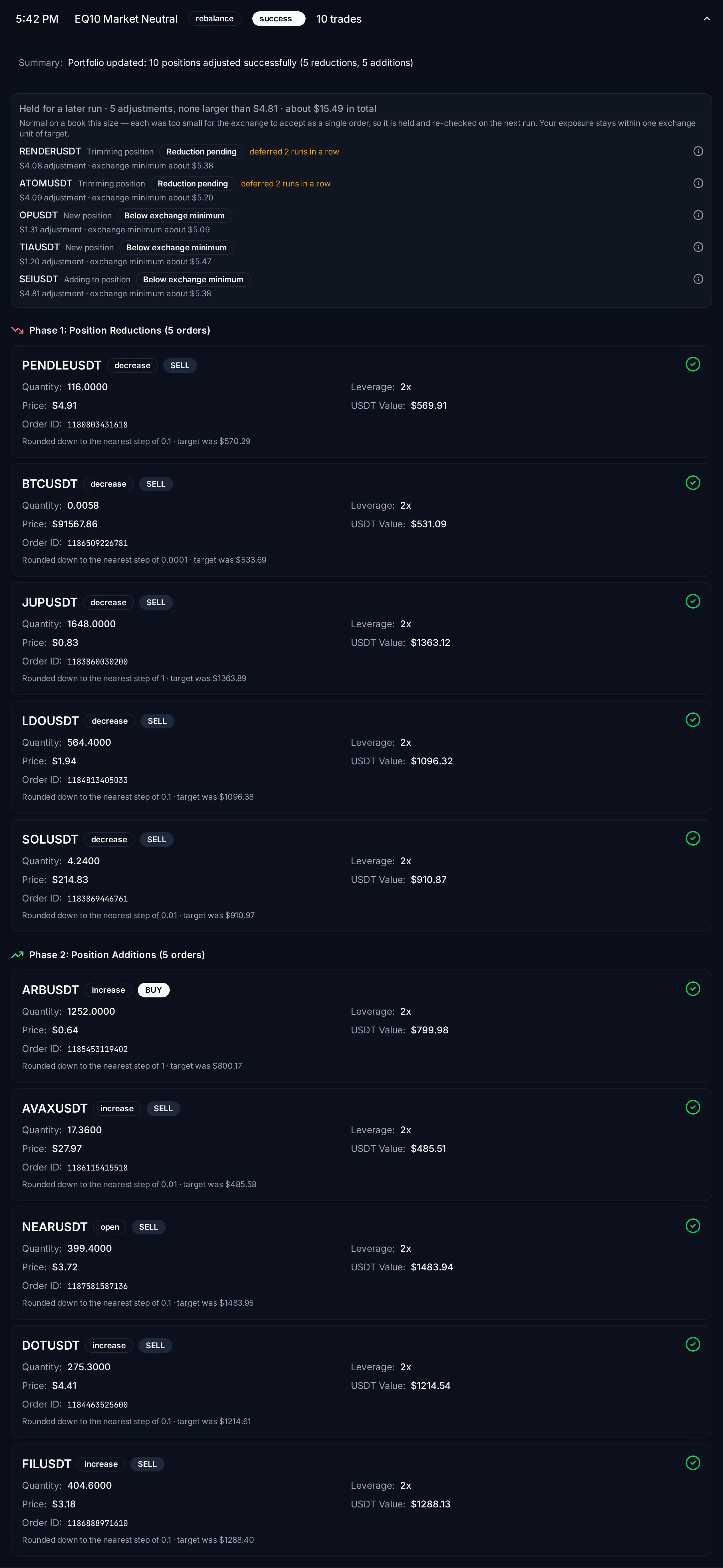
A run on Trade history: the held group first, then the orders that went out.
Day one is the least representative run you will see: every position is an opening trade, so it is the most trading the strategy will ever do in a single day.
Days 2 to 7: much less happens
Section titled “Days 2 to 7: much less happens”Each run trades only the difference between your book and target, so a typical day places a handful of orders against twenty open positions. A quiet run is a healthy run.
Things that will look wrong and are not:
| What you see | Why |
|---|---|
| Net exposure near zero | The strategy is market-neutral. This is the goal. |
| Gross exposure above your equity | Long plus short exceeds equity by design. |
| More held orders than filled orders | Sub-lot adjustments cannot be expressed as orders. |
| Assets you have never heard of | The universe is the full perpetuals list, not the majors. |
| A long and a short both losing | Independent bets on relative value, not a hedge pair. |
| P&L moving with no orders placed | Prices move continuously. The system trades once a day. |
Your P&L will move around, a lot
Section titled “Your P&L will move around, a lot”A market-neutral book at roughly 2x gross swings meaningfully day to day. On a five-figure account, daily moves of a percent or more are unremarkable.
Do not measure from the peak. Measuring down from the highest point of a noisy series produces a “loss” that is mostly noise. Use the period selectors so you compare like with like.
Do not annualise a short window. A bad fortnight extrapolated to a year is alarming and meaningless. The app shows a dash until there is enough history.
What to actually watch
Section titled “What to actually watch”Three things, and none is the P&L.
Did every run execute? Trade history should show one run per scheduled day. A missing day is worth investigating; a late one is not.
Is your exposure near target? Compare gross exposure on Portfolio against the target on Systems. A few percent apart is routine, persistently far apart is not. See Target exposure.
Are held orders clearing? Individual held orders are fine. The same reduction held five runs running is flagged by the app and is worth a look.
Things you cannot do
Section titled “Things you cannot do”No close position button. Portfolio is read-only. To exit, stop the system, which offers to liquidate.
No manual trade entry. The book is the strategy’s output.
No stop-losses to configure. Risk is managed through position sizing, diversification and regime scaling.
No way to trigger a run.
If your exposure suddenly halves
Section titled “If your exposure suddenly halves”The most alarming thing that can happen in a normal first month, so know it in advance: when our risk rules classify the market as unfavourable, the system deliberately cuts your whole book to roughly half its usual size. Your leverage setting is untouched and nothing is broken. Read Regime scaling.
When to ask for help
Section titled “When to ask for help”- A scheduled run missing entirely for more than a day.
- A connection stuck in a failed state after retesting.
- The same reduction held for five or more consecutive runs.
- Numbers that contradict each other in a way Troubleshooting does not explain.
Support is the chat widget in the app.
After the first week
Section titled “After the first week”Read The mental game next. The setup was the easy part; the first two months of watching it run are where people make their expensive mistakes, and that page exists to head them off.
For the mechanics, The daily rebalance and Target exposure together explain essentially everything the product does with your money.