

Trade history
Trade history is the read-only audit trail: every run, every order inside it, and a plain-English reason for anything held back.
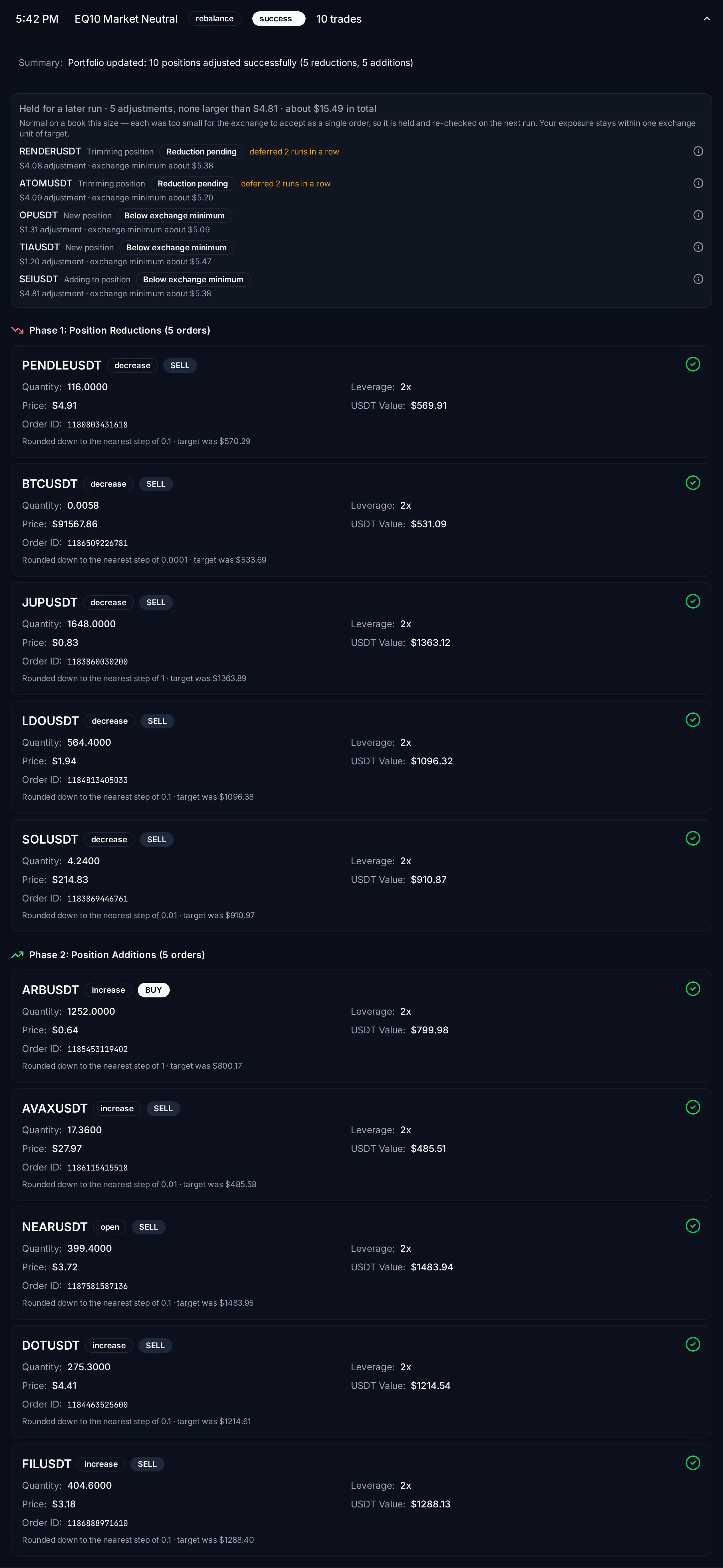
A single run expanded: the held group, then the orders that went out.
Picking a window
Section titled “Picking a window”Two date pickers set the range, and Last 30 Days resets to the default. Runs group by day, newest first, each header carrying that day’s execution and trade counts.
The run row
Section titled “The run row”Each run is a collapsible row showing the local time, the system, the execution type, a status badge, and the trade count. Open it for the detail, which starts with a one-line summary. Older runs may say detail is unavailable, meaning they predate structured tracking.
Held for a later run
Section titled “Held for a later run”The most common thing people come here to understand. Adjustments too small for the exchange to accept as a single order are grouped, with the reassurance stated once at the top:
Normal on a book this size. Each was too small for the exchange to accept as a single order, so it is held and re-checked on the next run. Your exposure stays within one exchange unit of target.
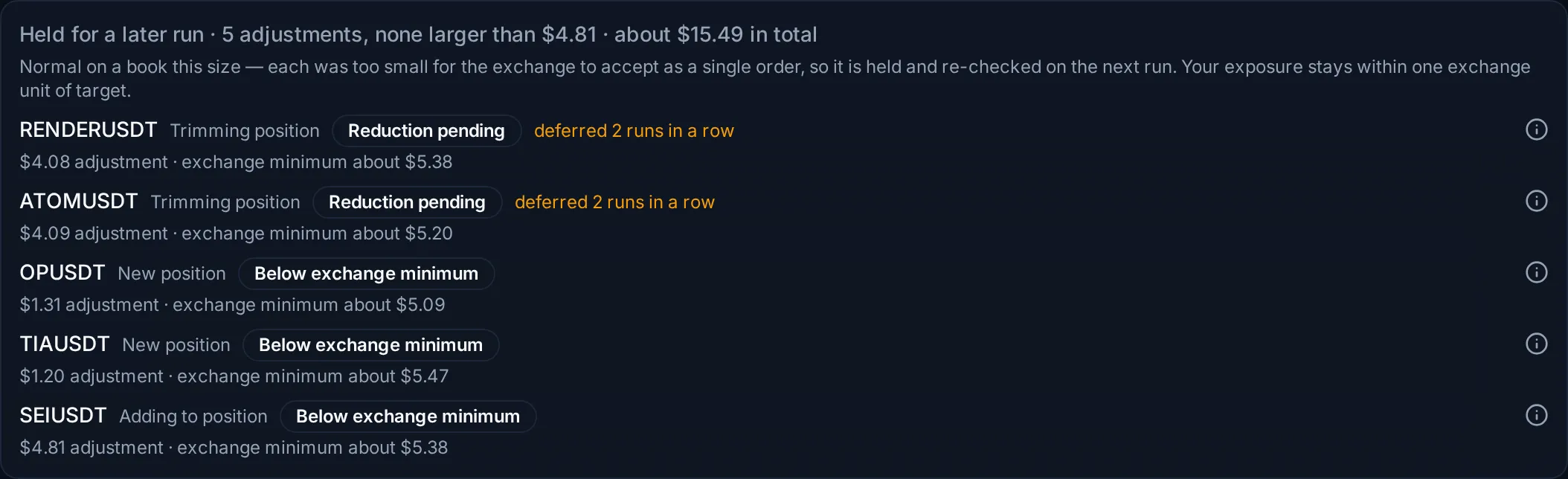
The held group. Each row names the direction, the outcome, and the two figures that explain it.
The header summarises the set, for example 13 adjustments, none larger than $6.51, about $43.79 in total. The total is gross, not net: a missed trim and a missed add do not cancel out, since each is independently off target. When only some rows recorded a size, the header says so rather than quoting a figure covering fewer rows than you see. It may also mention sub-lot residuals too small to itemise, held for the same reason but not listed.
Each row gives the symbol, what the order would have done, a short label, and usually the adjustment size and the smallest accepted order.
A row may carry an amber deferred N runs in a row note. One run of holding is expected. Five or more is not, and that row moves into Other outcomes.
Full background: orders that were held.
Other outcomes
Section titled “Other outcomes”A separate group for anything not routine. If a run has one, read it. Two land here by design:
- Market data missing. We could not confirm this market’s order size increment, so no new position was opened. Closing is unaffected.
- No usable price. No reliable price was available, so nothing was placed.
Anything this build does not recognise lands here too, because an unexplained outcome must never sit under a banner saying it is normal.
The other held labels you may see
Section titled “The other held labels you may see”| Label | Meaning |
|---|---|
| Below one lot | Smaller than one tradable unit of this market. |
| Below exchange minimum | Below the exchange’s minimum order size. |
| Reduction pending | Above target by less than the exchange will trade in one order. |
| Below minimum after price move | The price moved between sizing and placing, leaving the order under the minimum. |
| Closed in full | Trimming would have left a remainder too small to trade later, so the position was closed completely instead. This one did go out. |
Leverage Capped
Section titled “Leverage Capped”An amber block listing any symbol where the leverage requested exceeded what the venue allows, with both figures. Exchanges set per-symbol caps, and this is the system respecting them.
Phase 1 and Phase 2
Section titled “Phase 1 and Phase 2”Orders run in two phases, always in this order:
- Phase 1: Position Reductions. Closes and trims: selling longs, buying to cover shorts.
- Phase 2: Position Additions. Opens and increases: buying longs, selling to open shorts.
Reductions go first so the margin they release funds the additions. See the daily rebalance.
Reading an order card
Section titled “Reading an order card”Each order shows the symbol and two badges, the action and the order side.
| Action | What happened |
|---|---|
open |
A new position was started. |
increase |
An existing position was added to. |
decrease |
An existing position was trimmed. |
close |
A position was closed out. |
flip |
A position was reversed, long to short or the reverse. |
Below that: quantity, leverage, price, USDT value, and the exchange’s order ID. Green tick means placed, red cross means not.
You may also see:
- Rounded down to the nearest step of N, target was $X. The order went out slightly smaller than requested, since exchanges trade in fixed increments.
- Exchange Error with the venue’s own message, the market’s increment and its smallest accepted order, so the numbers reconcile.
What to do when a run looks alarming
Section titled “What to do when a run looks alarming”- Lots of held adjustments. Normal. The header usually shows a dozen sub-$10 nudges rather than one large failure.
- Anything in Other outcomes. Worth a look. If it recurs on one symbol across several runs, get in touch.
- A symbol deferred five or more runs running. Not self-correcting. Raise it.
- A failed run. Start with the summary and error text on the run.